


Revolutionizing the Road: How Ford is Bringing Affordable EVs to America Without the Assembly Line
For decades, the assembly line has been the foundation of the automotive industry. It was pioneered by Henry Ford in the early 1900s, and has since become the standard method of production for cars and other mass-produced goods. However, with the rise of electric vehicles (EVs) and the need for more sustainable transportation options, Ford has decided to break away from this traditional approach and revolutionize the road by introducing a new way of manufacturing EVs.
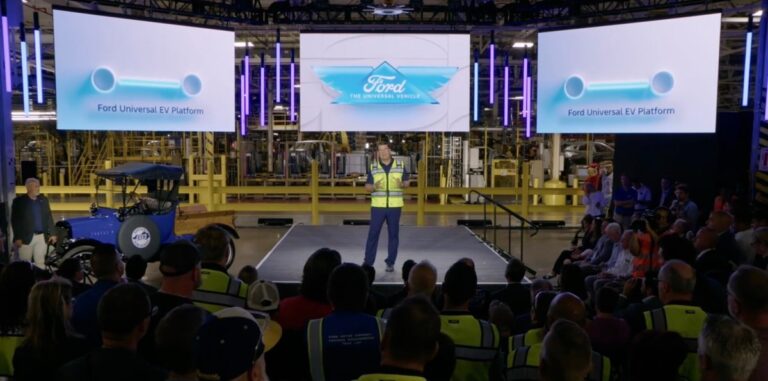
In a surprising move, Ford recently announced that it would be throwing out Henry Ford’s assembly line and implementing a new, streamlined approach to producing EVs in America. This decision has caused quite a stir in the automotive world, with many questioning the feasibility and effectiveness of this new method. However, Ford remains confident that this change will not only allow them to produce more affordable EVs, but also significantly reduce their carbon footprint.
So, what exactly is this new approach that Ford is adopting? It’s called “flexible manufacturing” and it involves using a modular platform to build EVs. This means that instead of a fixed assembly line with dedicated workstations for each step of the production process, Ford will have a flexible production line that can be easily reconfigured to accommodate different models and variations of EVs. This will allow for more efficient and cost-effective production, as well as the ability to quickly adapt to changes in consumer demand.
But why is Ford making this change now? The answer lies in the growing demand for EVs. With the rise of climate change concerns and the push for more sustainable transportation, the demand for EVs has been steadily increasing. However, the high cost of production has made it difficult for automakers to offer affordable EVs to the mass market. By implementing flexible manufacturing, Ford hopes to reduce production costs and make EVs more accessible to the average consumer.
This move also aligns with Ford’s commitment to sustainability. The traditional assembly line method is not only costly, but also generates a significant amount of waste and consumes a large amount of energy. With flexible manufacturing, Ford can reduce waste and energy consumption by as much as 50%. This not only benefits the environment, but also helps to reduce production costs, making EVs more affordable for consumers.
But how does this new method of production actually work? The key lies in Ford’s new Electric Global Modular Platform (E-GMP), which is a modular architecture designed specifically for EVs. This platform allows for various models and variations of EVs to be built using the same basic components, making the production process more efficient and cost-effective. Additionally, E-GMP also enables fast and easy customization, which allows Ford to quickly respond to changing consumer demands.
Another advantage of flexible manufacturing is the ability to produce multiple models on the same production line. This means that Ford can produce both traditional gas-powered vehicles and EVs on the same line, reducing the need for separate facilities and further streamlining the production process.
So, what does this mean for the future of EVs in America? With Ford’s commitment to flexible manufacturing and the production of affordable EVs, we can expect to see a significant increase in EV sales in the coming years. This not only benefits the environment, but also the economy, as the demand for EVs will create more jobs in the automotive industry.
Furthermore, Ford’s decision to move away from the traditional assembly line may inspire other automakers to follow suit. As EVs become more popular and the demand for affordable options increases, traditional assembly lines may prove to be a hindrance to the production of EVs. By adopting flexible manufacturing, automakers can effectively meet the needs of consumers and contribute to a more sustainable future.
In conclusion, Ford’s decision to throw out the assembly line and implement flexible manufacturing for EVs is a bold and innovative move. It not only allows for more efficient and cost-effective production, but also aligns with Ford’s commitment to sustainability. With the potential to make EVs more affordable and accessible to the average consumer, this change has the power to revolutionize the road and pave the way for a greener future.
Referência:
Clique aqui
